Research
Ultrasonic deep-subwavelength defect shape reconstruction imaging
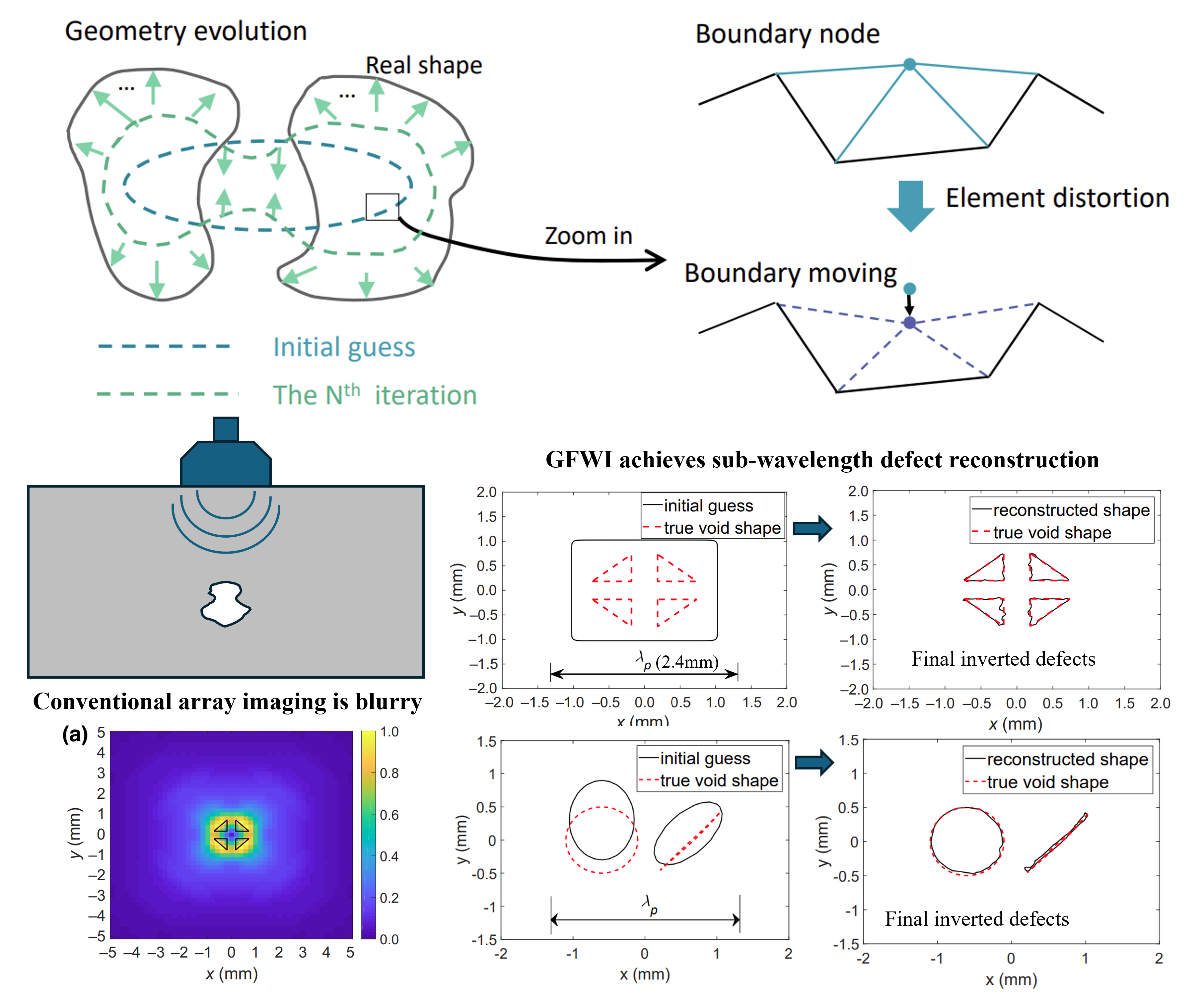
Realistic defects including cracks and usually have complex shapes with features varied from millimetres to micrometre scales. Traditional ultrasonic array imaging methods are limited in the resolution due to diffraction effects, and tend to produce vague images from which it is difficult to extract defect shape characteristics. To enable multi-scale shape reconstruction of defects for revealing all the details, we are developing novel full waveform-based shape inversion methods, e.g., geometrical full waveform inversion (GFWI). The method maximise the use of waveform physics, integrated with a novel geometrical inversion scheme that can capture all the defect scattering information, leading to imaging multiple arbitrary defects with a deep-subwavelength resolution toward micrometre scales.
Ultrasonic wave scattering from complex defects
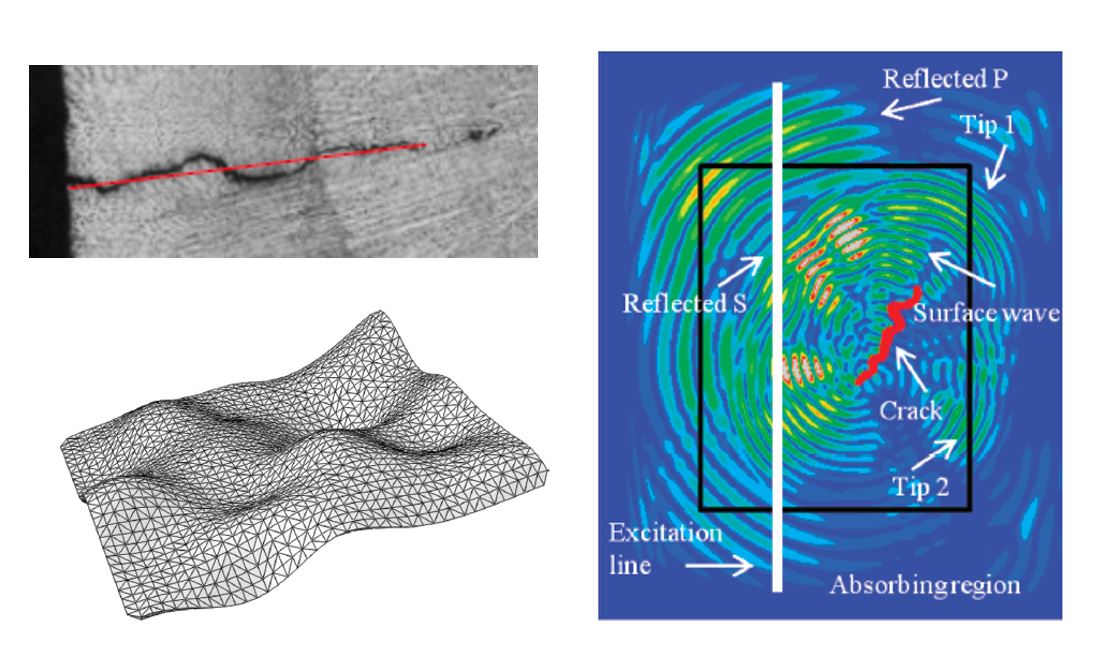
Defects such as thermal fatigue cracks or stress corrosion cracks exhibit rough surfaces and complex shapes. However, most of traditional inspection standards are based on elastic wave scattering from cracks with relatively simple shapes, the wave physics of which are well understood. Wave scattering from a complex defect, including reflections, diffractions and mode conversions, are much more complicated than those from a simple crack. Every complex or random crack is different and hence statistical wave models need to be developed to predict the stochastic scattering.
The knowledge from this project is critical to help the industry to increase the inspection reliability and accuracy, and avoid miss calls of non-existing defects. The research focuses on both mathematical modelling of statistical elastic wave scattering, and more application-oriented research for accurate characterisation of rough defects.
Ultrasonic non-invasive characterisation of batteries and health monitoring
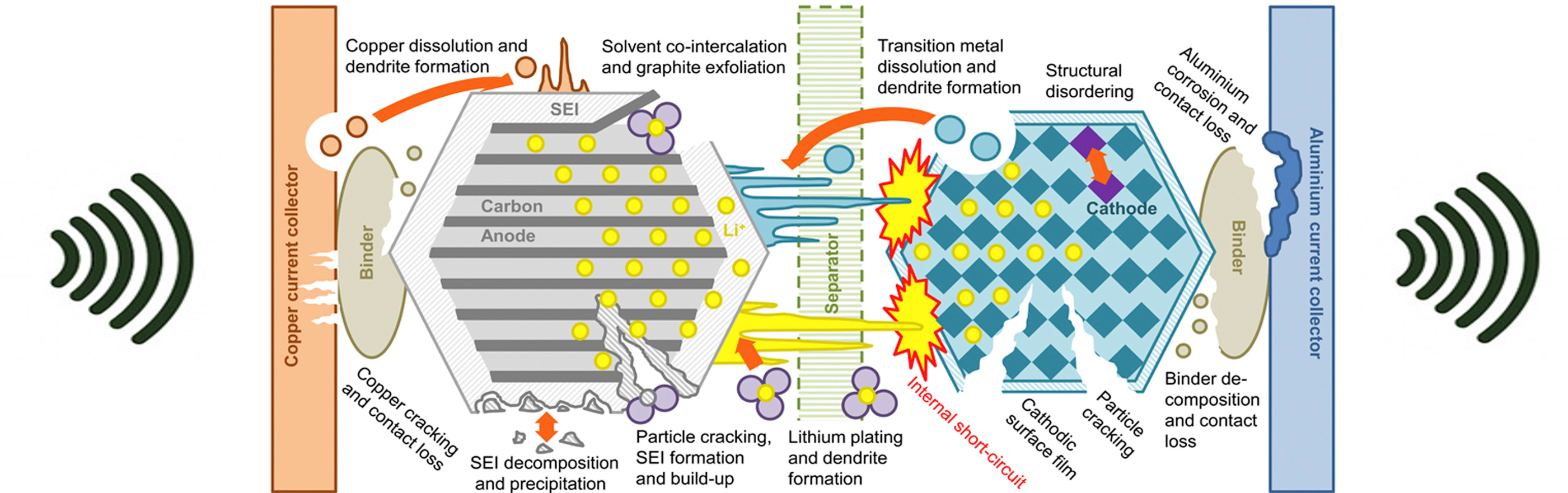
Batteries especially Li-ion batteries are known to suffer from safety risks and thermal runaway. The safety incidents can be caused by battery material aging during charging/discharging cycles or tiny pre-existing defects from imperfect manufacturing process. We have been developing novel ultrasound-based inspection and monitoring approaches to detect and characterise these defects inside batteries, and to assess the state of health in a more accurate way. We investigate the wave propagation mechanisms inside the complex battery structures, and develop new battery imaging methods to reveal the interior structures and anomalies.
Deep learning based ultrasonic defect characterization
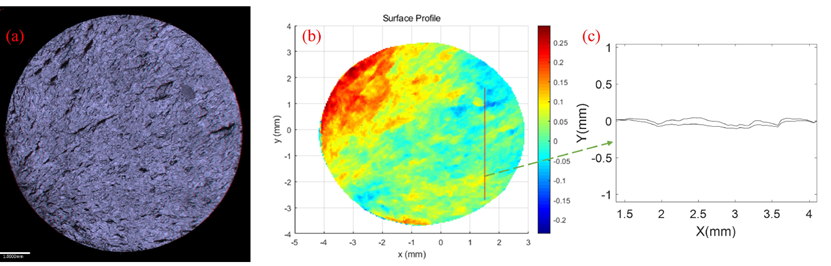
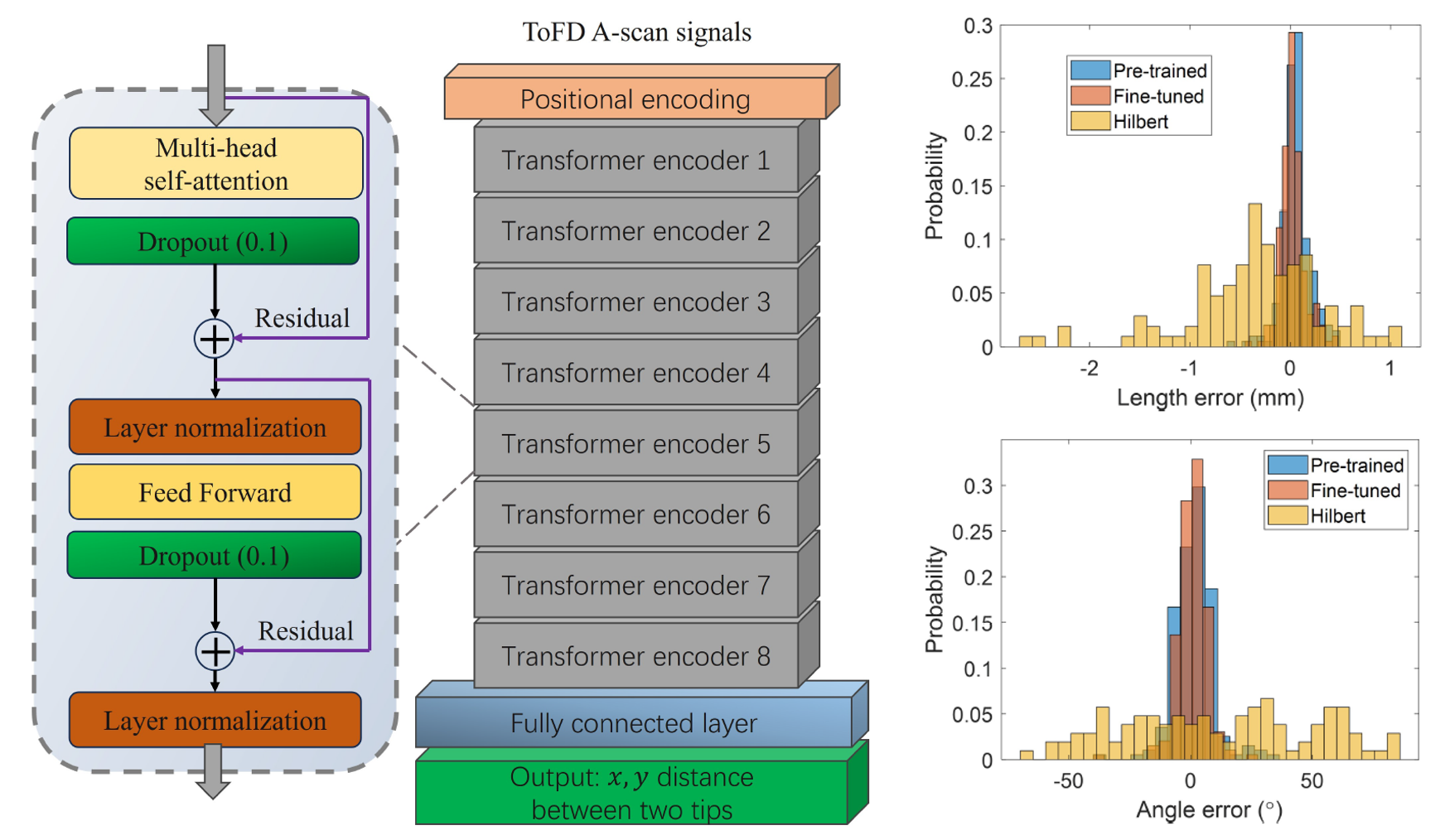
Ensuring the safety of engineering components and structures relies heavily on the detection and characterisation of internal defects, such as cracks. Naturally-grown defects often have randomly rough surfaces. However, traditional ultrasonic inspection methods still face limitations in detecting and characterizing rough defects. This is primarily due to the complex physical nature of scattering and diffraction from complex defect shapes, and the lack of tools for correctly interpreting the signals.
This research focuses on developing the deep learning based methods to accurately and efficiently characterize rough defects. With the deep learning based method, the accuracy of rough defect characterization increases dramatically compared to the conventional ultrasonic based inspection method, demonstrating the potential interest of implementing the AI-aided method to improve the reliability of ultrasonic NDE.
Advanced ultrasonic imaging for defect/material characterisation
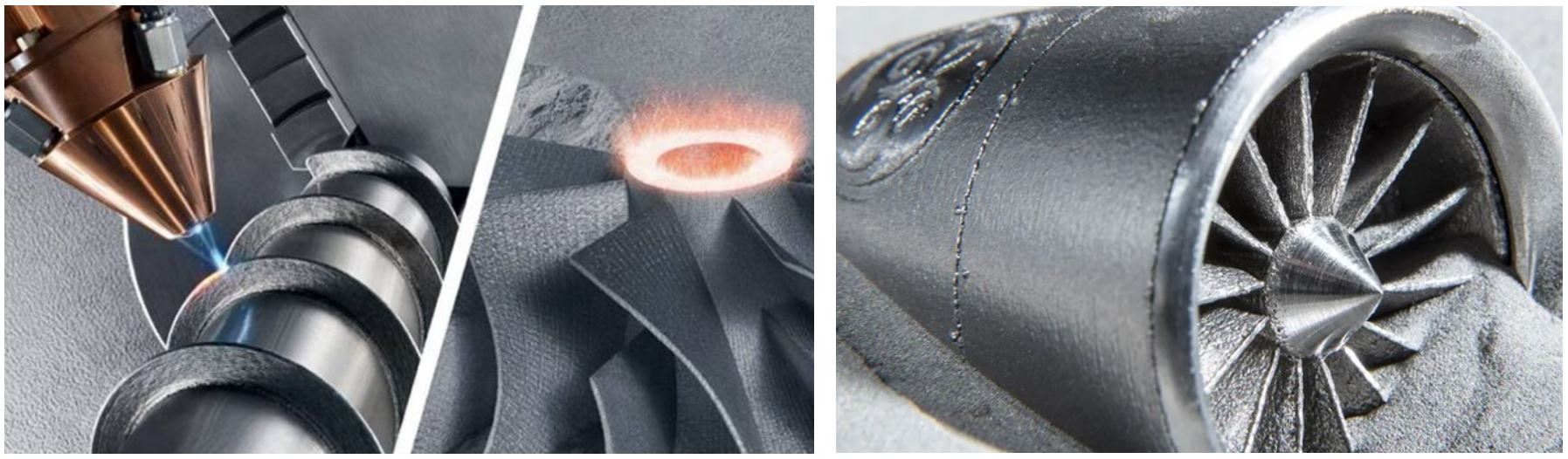
Additive manufacturing (AM) offers the capability of combining materials to fabric objects in three dimensions in a layer-by-layer fashion. It is significantly advancing the manufacturing industry, due to the advantages of creating complex shapes and unprecedented level of product customization. However current AM technology is not reliable and mature enough to control the quality of the metal parts. This project aims at developing an ultrasonic method to realise online monitoring of the AM process, to achieve fully robust 3D printing and improved quality of the product. The project is in collaboration with the AM research group in HKUST.